 vs
vs
KlipKap Pro vs Screen Studio: which to buy
Updated September 2026 · we make KlipKap, so weigh the opinion accordingly. Every Screen Studio figure below comes from their own public pages and is linked at the bottom.
The short version
KlipKap Pro wins this on the two things that decide it and most of what sits underneath. It runs the same cinematic workflow on Windows and macOS where Screen Studio is Mac-only, and costs a single payment against $108 every year. It also does more inside one application: three-axis auto-zoom control, twelve cursor styles, six voice repair controls, automatic silence removal, and 4K export at 120 fps with GPU acceleration. Screen Studio remains a capable Mac application with a longer track record.
How we checked. The KlipKap column comes from using the product. Every Screen Studio claim comes from their own pricing and feature pages rather than from a review site, and where we could not confirm something we say so instead of filling the gap. Feature availability changes; the date at the top is when this was last verified.
Which machines it runs on
Before any feature matters, the application has to start. Teams are rarely all on one platform, and a tool half the team cannot open produces recordings that do not match.
KlipKap Pro
Windows 10 and 11, and macOS 13 Ventura or later, with the same features, the same interface and the same price on both.
Screen Studio
Screen Studio is macOS only. For a Windows machine it is not a purchase decision at all.
KlipKap Pro. This row ends the comparison outright for a large share of readers, and it does not rest on judgement.
Automatic zoom, and how much of it you control
Both move the camera to where you are working so a raw capture comes out looking edited. The difference appears on the takes where the default is wrong: a zoom that fires on the wrong click costs more time to undo than it saved.
KlipKap Pro
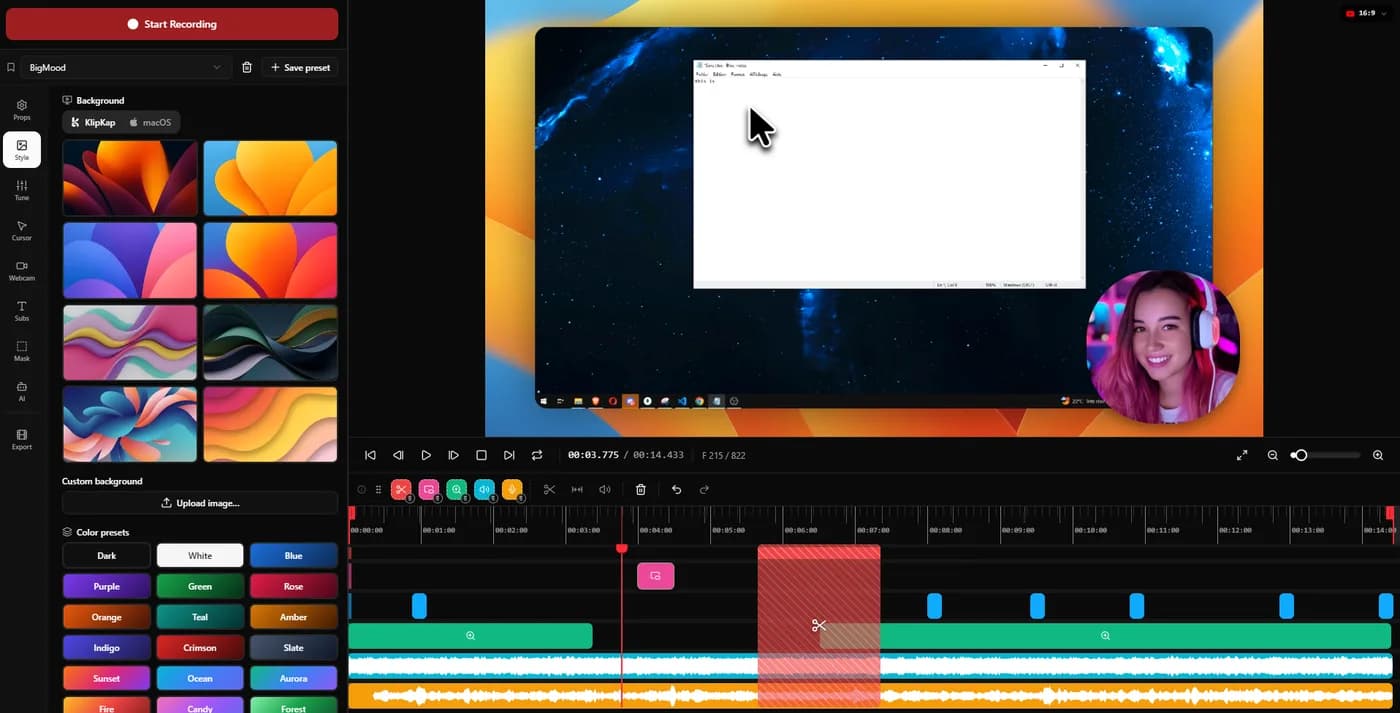
Three separate dials rather than one switch. Intensity from 1.0x to 4.0x, mouse smoothing from 0 for instant tracking to 1 for maximum lag, and zoom speed from slow acceleration to snap. Any individual zoom can also be taken off cursor-following and aimed at a fixed point with a crosshair on a preview canvas.
Screen Studio
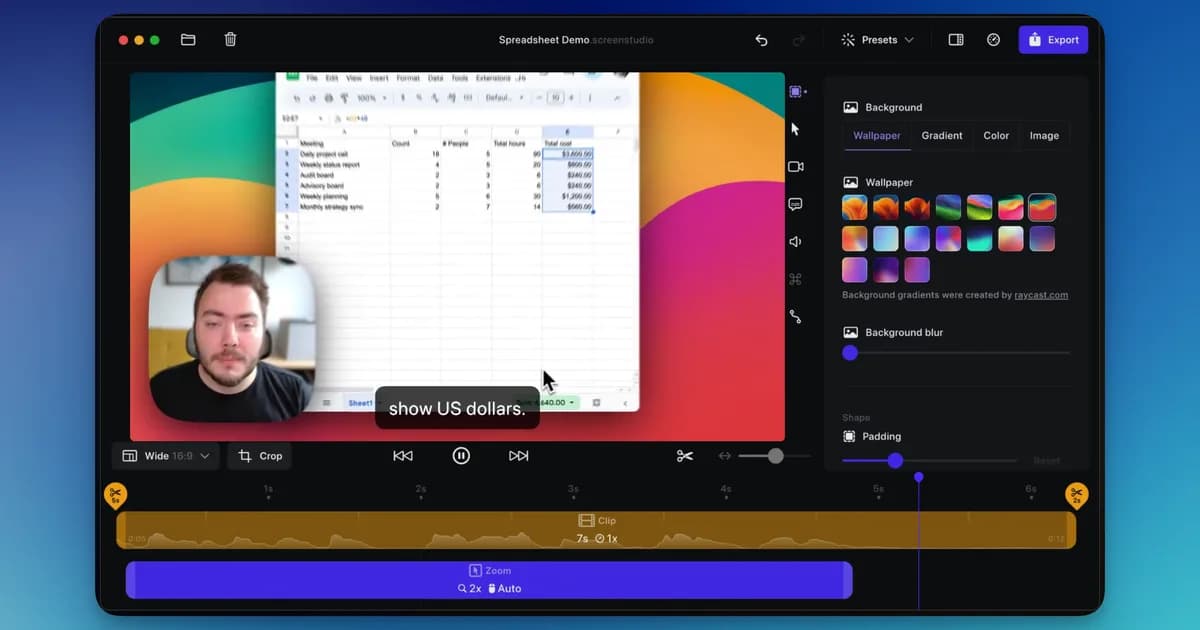
Zoom segments appear as clips on the timeline and can be moved or removed. The published controls are coarser than a three-axis model, though the defaults suit a standard walkthrough.
KlipKap Pro, on control. When the automatic placement fits your material both are fine; three dials and per-zoom targeting are what get you out of it when it does not.
The pointer itself
In a screen-led video the cursor is what the viewer follows. A captured pointer is whatever the operating system drew at the time, usually too small to read once the video sits at half width on a page.
KlipKap Pro
The cursor has its own panel: twelve styles including animated ones, adjustable size and shadow, a tilt toggle that leans it into its direction of travel, and an option to hide it whenever it stops moving. It is redrawn at export rather than captured, so all of that can change after the recording exists.
Screen Studio
Cursor smoothing is part of the core product and works well. Restyling the pointer, resizing it or hiding it when idle is not documented on the public feature pages.
KlipKap Pro. Smoothing the path is common; changing what the viewer is actually looking at is not.
Captions, and where the audio goes to get them
Most screen video is watched without sound at least once. How a tool produces captions decides whether they are free, whether they are rationed, and whether your audio leaves the building.
KlipKap Pro
Transcription runs on your machine with a choice of model size: no API key, no per-minute charge, no upload. Progressive word highlight dims the words you have not said yet by an amount you set. Transcription is a Pro feature rather than part of the free tier.
Screen Studio
Screen Studio also produces captions on-device, which is a genuine reason to pick it over cloud-based tools. Word-level styling control is more limited than a full progressive-highlight system.
KlipKap Pro, narrowly. Both keep the audio local, which most of this category does not. The difference is the styling on top.
Repairing the audio you actually recorded
A good take with bad audio is an unusable take, and re-recording is the expensive fix. What matters is whether the repair lives in the same application or means exporting to something else.
KlipKap Pro
Six controls applied at export rather than baked in: cleanup for low-frequency rumble, adaptive noise suppression, bass boost, voice clarity, voice boost and a de-esser around 7 kHz. Silent stretches are detected and removed automatically, which is the biggest single saving on a long unscripted take.
Screen Studio
Automatic microphone cleanup is included and handles ordinary room noise competently. Granular control over the individual stages, and automatic silence removal, are not documented.
KlipKap Pro. One-button cleanup covers the ordinary case; six controls plus silence trimming cover the take you would otherwise shoot again.
What comes out, and how long it takes
Export is where a quick edit turns into a slow afternoon. Resolution and frame rate set the ceiling; whether the render uses the GPU decides whether a ten-minute 4K piece is a coffee break or a lunch break.
KlipKap Pro
MP4 and GIF, up to 4K, at 24, 30, 60 or 120 fps, GPU-accelerated. Six aspect ratios cover YouTube, TikTok and Instagram, X, LinkedIn and Facebook alongside the source dimensions, so a 16:9 demo becomes a 9:16 clip without reframing by hand.
Screen Studio
High-quality MP4 export with social ratios. 120 fps output and GIF are not documented on the public feature pages.
KlipKap Pro. 4K at 120 fps with GPU acceleration is not matched in this category outside OBS, which is a live-streaming tool rather than an editor.
What it costs over the time you own it
A subscription that looks small compounds. The question is not the monthly figure but what the tool costs across the years you keep using it, and whether you still have it if you stop paying.
KlipKap Pro
$25.49 once, updates included, no major-version upgrade fee. A permanent free tier at 720p with a watermark lets you test the automatic zoom against your own material before any money changes hands.
Screen Studio
$9 a month billed annually, so $108 up front and $108 again every year, or $29 a month billed monthly. No permanent free tier, and the one-time licence they used to sell was withdrawn for new customers in October 2025.
KlipKap Pro. Break-even arrives inside three months; across five years the gap is roughly $515, and you still own the licence at the end.
Current plans
KlipKap Pro
- Pro: $25.49 once, updates included, no renewal
- Free: permanent, 720p with a watermark, no time limit
- Windows 10/11 and macOS 13 or later, same price on both
- One account, unlimited machines, no device count to manage
- 14-day money-back guarantee
Screen Studio
- $9/month billed annually, so $108 per year
- $29/month billed monthly
- One-time licence withdrawn for new customers, October 2025
- No permanent free tier
- macOS only
When to choose KlipKap Pro
How much of the tuning you can reach
Both products have their own effects engine, and Screen Studio's is well tuned: it defined what this category is supposed to look like. The difference is philosophy. Screen Studio is deliberately opinionated, and most of its motion is decided for you because deciding well is the product. KlipKap Pro exposes it: intensity from 1.0x to 4.0x, cursor smoothing from instant to maximum lag, zoom speed, and any single zoom taken off cursor-following and pointed at a fixed spot. If the defaults suit your footage, that difference costs you nothing. The first time they do not, it is the whole difference.
You want that finish without giving up the controls
The exported result stands beside anything Screen Studio produces, and the difference is what happens before the export. Every automatic pass stays editable: each zoom can be retargeted by hand or switched to a fixed frame, the cursor has twelve styles with tilt and hide-when-idle, and the window styling goes from shadow to padding to background. Nothing is decided for you and locked.
You would rather buy than rent
$25.49 once against $108 a year. If you record in bursts around launches rather than weekly, you are paying for eleven quiet months to use the tool in the twelfth.
You want the whole workflow in one app
Captions, six voice repair controls, silence trimming and social ratios are included rather than handled by a second tool and a second subscription.
When Screen Studio is the better fit
You are Mac-only and already invested
If your team is entirely on macOS, this year is paid for and the tool fits how you work, switching mid-term buys you the money and nothing else. Revisit at renewal.
You want the longest track record
Screen Studio has been shipping longer than most of this category, which brings more tutorials and more people who have already hit whatever you are about to.
You prefer fewer settings
Three dials on the auto-zoom is control if you want it and clutter if you do not. Screen Studio makes more of those decisions for you.
Can you use both?
There is little reason to. This is the same job priced two ways rather than two different jobs. If you hold a subscription that runs to the end of the year, use it and revisit when the renewal lands or the first Windows machine joins the team.
Frequently asked questions
- Is KlipKap Pro better than Screen Studio?
- Better is the wrong frame, because they are not available to the same people. Screen Studio is macOS only, so for a Windows machine there is no comparison to make. Where both run, Screen Studio has the longer track record and defaults that need less adjusting out of the box. KlipKap Pro covers more of the workflow in one application, exposes more of the tuning, and costs $25.49 once against $108 every year. If the defaults suit your footage and the subscription does not bother you, staying is a reasonable decision.
- Does Screen Studio work on Windows?
- No. Screen Studio is macOS only and no Windows build has been announced. On Windows, KlipKap Pro is an option and Screen Studio is not, at any price.
- How much cheaper is KlipKap Pro?
- Screen Studio is $9 a month billed annually, so $108 in year one and $108 in every year after. KlipKap Pro is $25.49 once with updates included.
- Which has better automatic zoom?
- KlipKap Pro gives you more control: separate dials for zoom depth, cursor tracking and acceleration, plus per-zoom manual targeting for the moments when the thing worth showing is not where the pointer is. Screen Studio applies zoom competently with fewer settings to change.
- Can I try KlipKap Pro before paying?
- Yes, without a time limit. The free tier exports 720p with a watermark and never expires. Screen Studio has no permanent free tier.
Related comparisons
vs KlipKap Pro vs CursorClipTwo one-time purchases, one of them Mac onlyvs
 KlipKap Pro vs FocuSeeWhat a lifetime licence actually coversvs
 KlipKap Pro vs Tight StudioOn-device AI against metered creditsvs
 KlipKap Pro vs TellaDocumenting the interface against framing the presentervs
 KlipKap Pro vs LoomProducing video against sending itvs
 KlipKap Pro vs Screen CharmA focused subset against the full workflowvs
 KlipKap Pro vs CapOpen source against a finished workflowvs
 KlipKap Pro vs CamtasiaA demo tool against a course toolvs
 KlipKap Pro vs OBS StudioEditing after against broadcasting livevs
 KlipKap Pro vs CleanShot XVideo production against screen capture
Disclosure: this article is published by the team behind KlipKap Pro, one of the tools compared. Every price and platform claim is sourced below so you can check it rather than take our word for it. KlipKap has a free tier if you want to test it against the alternatives yourself.
Sources
Prices and platform support come from each vendor’s own pricing page, linked below. Software changes; if you spot something out of date here, tell us at contact@klipkap.pro and we will correct it.